How to Choose the Right HVAC System for Your Commercial Building in India
Choosing the wrong HVAC system is an expensive mistake. India's climate - from humid coastal cities to dry inland heat and cold northern winters - demands systems engineered for local conditions. Start with a heat-load calculation covering orientation, glazing, occupancy, equipment, lighting and fresh air rather than selecting equipment from floor area alone.
Compare systems by application
VRF or VRV offers flexible zoning and strong part-load performance for offices, hotels and mixed-use floors. Ducted splits and cassettes can be economical for smaller properties, while central chilled-water plants suit large buildings with stable demand and room for plant infrastructure. The best option is the one that matches operating hours, zoning and future expansion.
Efficiency and lifecycle cost
Compare seasonal ratings such as ISEER, estimated annual energy use, controls, refrigerant strategy, local spares and component life. Oversizing causes cycling and weak humidity control. Commissioning, balancing and sensible setpoints often save as much as premium equipment.
Maintenance and contractor selection
Ensure filters, coils, drains, pumps and outdoor units are safely accessible. Request a documented load calculation, equipment schedule, testing plan, as-built drawings, warranties and operator training. Compare proposals by complete scope and lifecycle cost, not tonnage and purchase price alone.
Need an HVAC assessment?
Our team designs, installs and commissions commercial HVAC systems.
Request a free consultationWhy Every Hotel in the Middle East Needs a Dedicated RO Water Treatment Plant
High TDS, salinity in some groundwater sources and demanding food-safety expectations make reliable water treatment essential. Hard water scales boilers, calorifiers, kitchens, laundries and guest-room fixtures, raising energy and replacement costs.
Size RO around real demand
RO membranes remove dissolved salts under pressure, but plant capacity must account for peak demand, source analysis, recovery, storage and redundancy. Filtration, softening or antiscalant pretreatment protects membranes and strongly affects reliability.
Integrate STP and reuse
A complete strategy includes wastewater. Treated sewage can support irrigation, flushing or cooling-tower make-up where permitted. Match the biological process and polishing stage to the intended reuse, then provide safe storage, monitoring and operator procedures.
Compliance and supplier selection
Design must follow the relevant UAE, Saudi, Qatari or Omani authority and hotel brand standard. Ask suppliers to guarantee output quality, recovery and energy use, and confirm testing, chemicals, membranes, spares, training and maintenance support.
Plan a dependable hotel water system
Request a water assessmentSolar-Powered Pump Sets for Agriculture in India - Complete Guide
Solar pumping can power irrigation, borewell supply and livestock watering without relying on expensive diesel or inconsistent grid supply. Panels drive a DC pump directly or feed an inverter for an AC pump; many farms store pumped water instead of electricity, avoiding batteries.
Select the right pump
Surface pumps suit open water and shallow sources, while submersibles lift from borewells. DC systems can excel at smaller duties; AC systems offer wider pump availability and suit larger or hybrid installations.
Size from water need and head
Calculate daily litres and total dynamic head, including lift, drawdown and friction. Use the resulting duty point to select the pump and then size the array for the motor, local solar resource and desired pumping window. Horsepower alone is not a design method.
PM-KUSUM and ownership
PM-KUSUM processes, approved vendors and subsidies vary by state and application period, so verify the current official scheme before buying. Demand pump curves, seasonal output estimates, dry-run protection, structural design, warranty and local service. Plan routine panel cleaning and cable inspection.
Size your solar pump correctly
Discuss your farm requirementBuilding Management Systems (BMS) - What You Need to Know
A BMS connects sensors, controllers and software so facility teams can monitor HVAC, lighting, metering, alarms and selected safety-system interfaces in one place. Offices, hotels, hospitals and large residences can use it to cut waste and stabilise comfort.
Benefits beyond the dashboard
Schedules prevent unnecessary runtime, setpoints stay consistent, alarms reach the right people and trends reveal faults early. The strongest energy opportunity is usually HVAC: coordinated chillers, pumps, air-handling units and zones can respond to real demand. Occupancy and daylight controls extend savings to lighting.
Delivery, cost and ROI
A proper project includes a points list, control philosophy, panels, networks, programming, graphics, testing and training. Cost and timing depend on building size and whether work is new-build or retrofit. ROI improves when the design targets measurable waste and includes submetering and post-handover optimisation.
Choosing a contractor
Define every controlled system, point, alarm and report. Prefer documented, open integration protocols where practical. Require backups, cybersecurity responsibilities, witnessed sequence testing and clear after-sales support.
Make your building work smarter
Book a BMS consultationMEP Engineering Services for Construction Projects in East Africa
From Nairobi offices to coastal resorts and industrial facilities, coordinated MEP work covers power, lighting, HVAC, plumbing, drainage, fire protection, water treatment, controls and solar. Early coordination prevents clashes and aligns utility needs with the architectural programme.
Design for local conditions
HVAC must account for heat, humidity, dust, coastal corrosion and power reliability. Borehole water should be tested before treatment design; filtration, softening, disinfection or RO may be needed. STP and reuse can support irrigation and other permitted non-potable uses.
Resilient energy and procurement
Solar can reduce operating costs while generators, protection systems and suitable controls maintain resilience. Imported equipment choices must consider shipping, duties, lead times, local spares and technician capability - not specification alone.
What to expect from an MEP partner
Check comparable regional projects, multidisciplinary coordination, authority knowledge and logistics capability. Require coordinated drawings, inspection and testing records, as-builts, training, warranties and a defined after-sales response.
Planning a project in East Africa?
Talk to our engineering teamWhat Is MEP Engineering? A Complete Guide for Building Owners
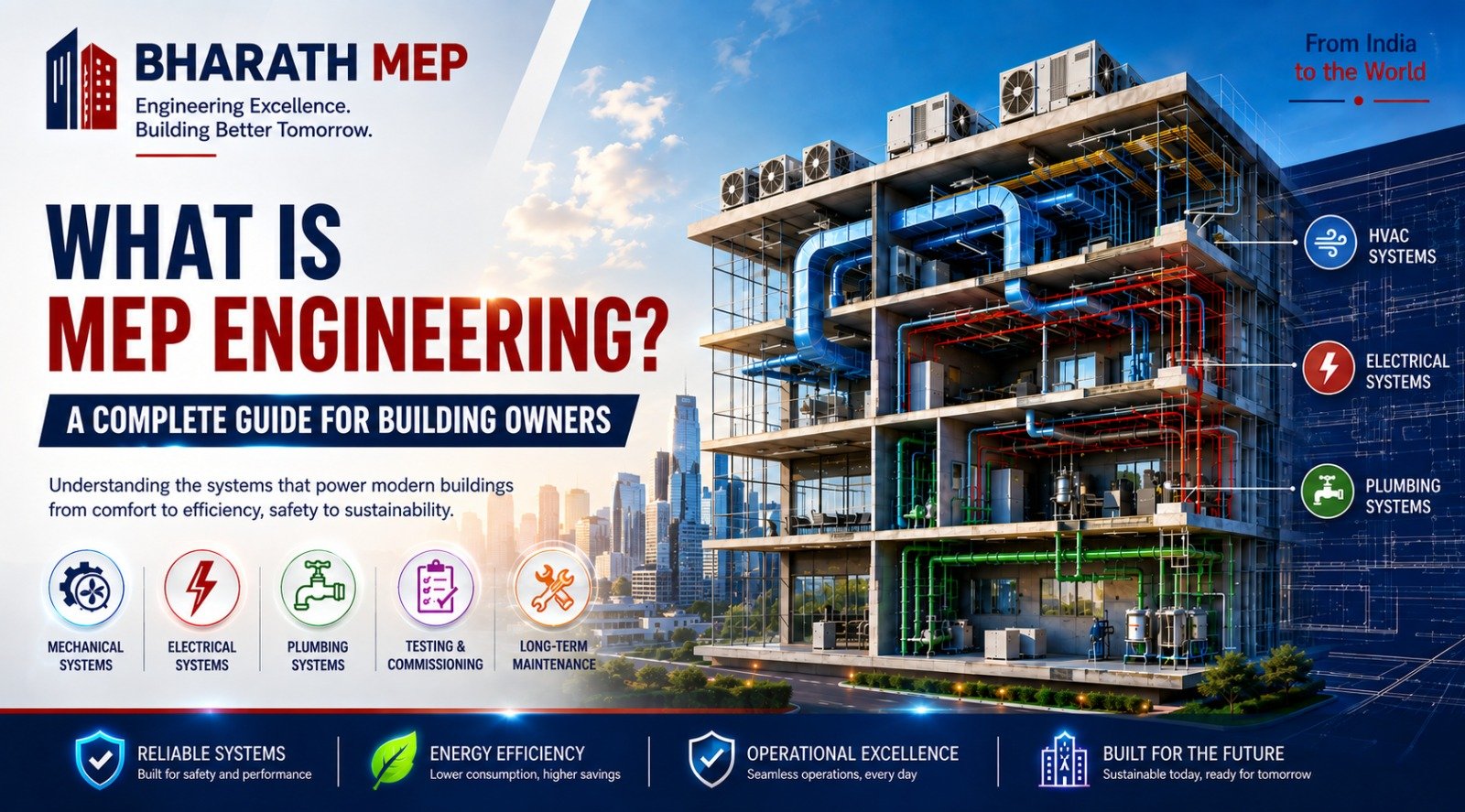
MEP engineering is one of the most important parts of any modern building, yet much of it remains hidden behind walls, ceilings, floors and plant rooms.
For a hotel guest, MEP systems provide comfortable temperatures, clean water, reliable electricity and a safe environment. For a shopping mall owner, they help maintain comfortable indoor conditions and uninterrupted operations. For a hospital, they support critical building services. For an industrial facility, they can directly influence productivity, energy consumption and operational reliability.
In simple terms, MEP stands for Mechanical, Electrical and Plumbing. Modern MEP engineering goes far beyond three individual disciplines. It coordinates multiple building systems so they work together efficiently throughout the lifecycle of a property - from design and equipment supply to installation, testing, commissioning and maintenance.
For building owners and developers, choosing the right MEP contractor can therefore have a major impact on construction quality, operating costs, energy efficiency and long-term building performance.
What does MEP stand for?
Mechanical, electrical and plumbing engineering form the technical backbone of a building.
Mechanical systems
Mechanical engineering within a building primarily covers systems that control the indoor environment and support mechanical operation. One of its most important components is HVAC - Heating, Ventilation and Air Conditioning.
Depending on the building and location, mechanical systems may include:
- Air conditioning and ventilation systems
- Chillers, cooling systems, VRF and VRV systems
- Air handling units, pumps and ductwork
- Mechanical equipment and building environmental controls
For hotels, hospitals, shopping malls and commercial buildings, HVAC is particularly important because indoor comfort and air quality can influence occupant experience and operational efficiency.
Electrical systems
Electrical engineering ensures that a building has safe, reliable and appropriately distributed power. Services can include power distribution, switchgear and panels, lighting, generators, UPS systems, cabling, earthing, protection, energy monitoring and electrical controls.
For a hotel or shopping mall, an electrical failure can affect everything from lighting and elevators to HVAC, security and customer operations. For industrial facilities, an interruption can affect production. Electrical systems should therefore be planned as part of the overall MEP strategy, not treated as an isolated installation.
Plumbing systems
A properly designed plumbing system manages the movement, storage, distribution and disposal of water throughout a building. Typical systems include potable water, hot and cold water, drainage, wastewater, water storage, pumping, sanitary systems, rainwater management and water-treatment interfaces.
For hotels, resorts, hospitals, apartments and residential communities, demand can be high and uninterrupted water availability is essential. On island projects, site conditions and available infrastructure also make water supply, treatment, storage and wastewater strategy important design considerations.
Why is MEP planning important?
A building may have excellent architecture and structural engineering, but without properly planned MEP systems it may not perform efficiently. MEP planning should ideally begin before construction starts so architecture, structure, HVAC, electrical, plumbing and other building systems can be coordinated.
HVAC ducts need ceiling space. Electrical systems need equipment rooms and distribution routes. Plumbing needs vertical shafts and drainage routes. Pumps, tanks, chillers and other equipment need adequate space and maintenance access. If these requirements are considered too late, projects may face design conflicts, rework, delays, limited access, higher costs and compromised performance.
How MEP engineering improves building efficiency
Good MEP engineering is not simply about installing equipment. It is about selecting, coordinating and operating systems to support the building's long-term requirements.
An energy-efficient building may combine efficient HVAC, smart controls, energy monitoring, solar energy, proper electrical design and preventive maintenance. Building automation can help property operators improve energy management, equipment operation, occupant comfort, monitoring and maintenance planning.
MEP for hotels and hospitality
Hotels operate continuously across guest rooms, restaurants, kitchens, conference spaces and back-of-house areas. MEP systems influence guest comfort, indoor temperature, water and hot-water availability, electrical reliability, energy consumption, automation and maintenance. Planning should therefore consider both construction and the full operational lifecycle of the property.
MEP for shopping malls and commercial buildings
Shopping malls and commercial complexes contain large numbers of people, tenants and operating systems. Their requirements can include centralised HVAC, electrical distribution, lighting, plumbing, water treatment, building automation, emergency systems and preventive maintenance. A coordinated MEP strategy supports both customer comfort and efficient operation.
MEP for hospitals
Hospitals require reliable services because many operations continue around the clock. Key considerations include HVAC and ventilation, electrical and backup power, plumbing and water systems, environmental controls, building automation, testing, commissioning and preventive maintenance. Decisions must reflect operational needs, safety considerations and applicable regulations.
MEP for industrial facilities
Depending on the industry, MEP systems may support manufacturing operations, process equipment, industrial HVAC, electrical power, water and wastewater requirements, compressed air, pumping, automation and energy management. System reliability is especially important because engineering failures can interrupt production.
MEP for apartments and residential communities
Residential developments require properly planned electrical distribution, water supply, drainage, HVAC, pumps, water treatment, solar systems, common-area services and building automation. Early planning helps create buildings that are comfortable, efficient and easier to maintain.
Why testing and commissioning matter
Installing MEP equipment is only one part of the process. Systems must also be tested and commissioned before a building becomes fully operational. This can include equipment, HVAC, electrical and plumbing testing; controls verification; system balancing; performance checks; documentation and handover.
A properly commissioned building gives owners greater confidence that the installed systems are ready for operation.
Why long-term MEP maintenance matters
The relationship with an MEP contractor should not necessarily end when construction is completed. Preventive maintenance can identify potential problems before they become major failures.
Maintenance may include HVAC inspection, equipment servicing, electrical inspections, pump maintenance, plumbing checks, control-system monitoring, filter replacement, performance checks and preventive repairs. Annual Maintenance Contracts can be an important part of a long-term MEP strategy.
Why choose an end-to-end MEP partner?
Building owners often need to coordinate architects, consultants, equipment suppliers, installation contractors and maintenance teams. An integrated MEP partner can connect every stage:
- Supply: selection and supply of appropriate equipment and materials.
- Installation: professional installation according to project requirements.
- Testing: verification of system performance and installation quality.
- Commissioning: preparing systems for reliable operation and handover.
- Maintenance: ongoing preventive maintenance and support.
This Supply, Install, Test, Commission and Maintain approach is at the heart of Bharath MEP's service philosophy.
Why Bharath MEP?
Bharath MEP provides complete engineering solutions for commercial, industrial and residential projects, bringing multiple building-service requirements together under one roof. Our capabilities include integrated MEP solutions, HVAC systems, solar energy, water treatment, building automation, and AMC and maintenance support.
From project planning and equipment supply to installation, testing, commissioning and long-term maintenance, Bharath MEP aims to give clients one engineering partner and one coordinated approach.
MEP engineering for international projects
Modern buildings across Saudi Arabia, the Caribbean and African island markets have diverse engineering requirements. Climate, building usage, local infrastructure, water availability, energy requirements and maintenance accessibility can all influence MEP decisions.
- Saudi Arabia: HVAC efficiency and building cooling are especially important in the region's hot climate.
- Caribbean hospitality markets: hotels, resorts and commercial properties require dependable HVAC, electrical, plumbing and water systems.
- African island markets: hospitality and residential developments may need careful consideration of water, energy, HVAC, corrosion exposure and infrastructure availability.
The engineering solution should be developed around the project, building type and local requirements rather than applying a one-size-fits-all approach.
Choosing the right MEP contractor
Before appointing an MEP contractor, building owners and developers should ask:
- Can the contractor handle multiple MEP disciplines?
- Do they provide supply, installation, testing and commissioning?
- Can they coordinate with architects, consultants and other contractors?
- Do they understand the operational requirements of the building type?
- Do they provide maintenance and after-sales support?
- Can they support commercial, industrial or residential projects?
- Can they deliver a coordinated, end-to-end solution?
MEP is the infrastructure behind the building
A building's success is not determined only by its architecture. Behind every comfortable hotel room, productive office, operational shopping mall, functioning hospital and efficient industrial facility are engineering systems working together.
From HVAC and electrical systems to plumbing, water treatment, solar energy and building automation, effective MEP planning contributes to comfort, reliability, efficiency and long-term maintainability. The objective is not simply to install MEP systems, but to create engineering infrastructure that performs throughout the life of the building.
Planning a new building or MEP upgrade?
Talk to Bharath MEP about an integrated approach from supply and installation to testing, commissioning and maintenance.
Request a consultationPowering Island Nations: Choosing Between Containerized and Open Gensets
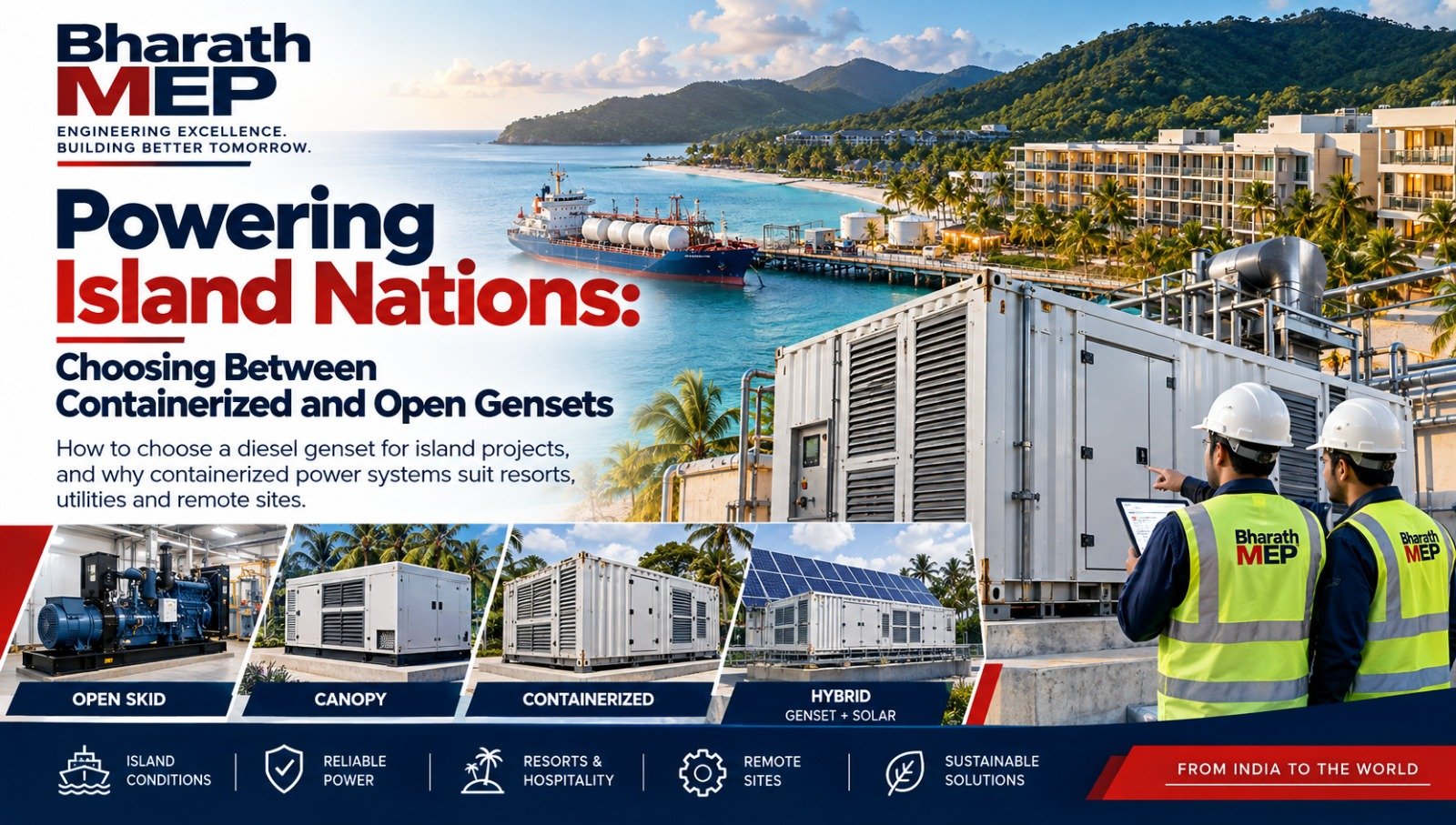
On an island, reliable power is never a given. Grid supply is often limited, fuel arrives by ship, and the nearest service engineer may be a flight away. A genset that performs well on the mainland can struggle in salt air, high humidity and cyclone season if it is not specified for those conditions.
Your main options
Open skid gensets have the lowest upfront cost and are easy to service. They need a proper powerhouse with ventilation, noise control and corrosion protection, so they suit sites that already have a plant room.
Canopy gensets add weather protection and lower noise, but still need a foundation, fuel tank and site cabling. They work well for smaller loads.
Containerized gensets come in 20-foot or 40-foot ISO containers with the engine, alternator, control panel, fuel tank, ventilation and silencing built in. They are tested at the factory, shipped as standard cargo and placed on a concrete pad. For resorts, remote sites and fast-track projects, this is usually the best fit.
Hybrid systems combine a genset with solar and batteries. The genset covers peak load and backup while solar cuts diesel consumption, which matters when every litre is imported.
Why containerized power works for islands
- Easy logistics: the unit moves as ordinary freight and handles well at small ports.
- Faster commissioning: on-site civil work is mostly a concrete pad rather than a complete building.
- Protection: the enclosure shields equipment from salt, rain, humidity and windborne debris.
- Low noise: essential where guests or residents are close to the plant.
- Fuel autonomy: integrated tanks or bulk-storage connections can provide days of runtime.
- Relocatable: the power plant can move if the site changes.
What to specify for island conditions
- Marine-grade coatings with stainless or galvanised fittings
- Derating for high ambient temperature and humidity
- Cyclone tie-down and wind-load ratings
- A defined sound-level target at one metre
- Fuel storage for 24 to 72 hours or more, with spill containment
- Paralleling capability for future expansion
- Remote monitoring when site visits can take days
- Spares, filters and a service plan agreed before shipping
- Compliance with local emission norms, import duties and customs requirements
Prime or standby?
Many island sites run gensets as their main power source, not just as backup. Units should be rated and sized for continuous duty. A standby-rated unit running every day will wear out far sooner than expected.
Work with Bharath MEP
Bharath MEP, based in Chennai, engineers and supplies containerized power solutions for island and hospitality projects overseas, from specification and sourcing to export documentation.
Planning an island power project?
Discuss your load, environmental conditions, logistics and future expansion plans with our engineering team.
Talk to Bharath MEP